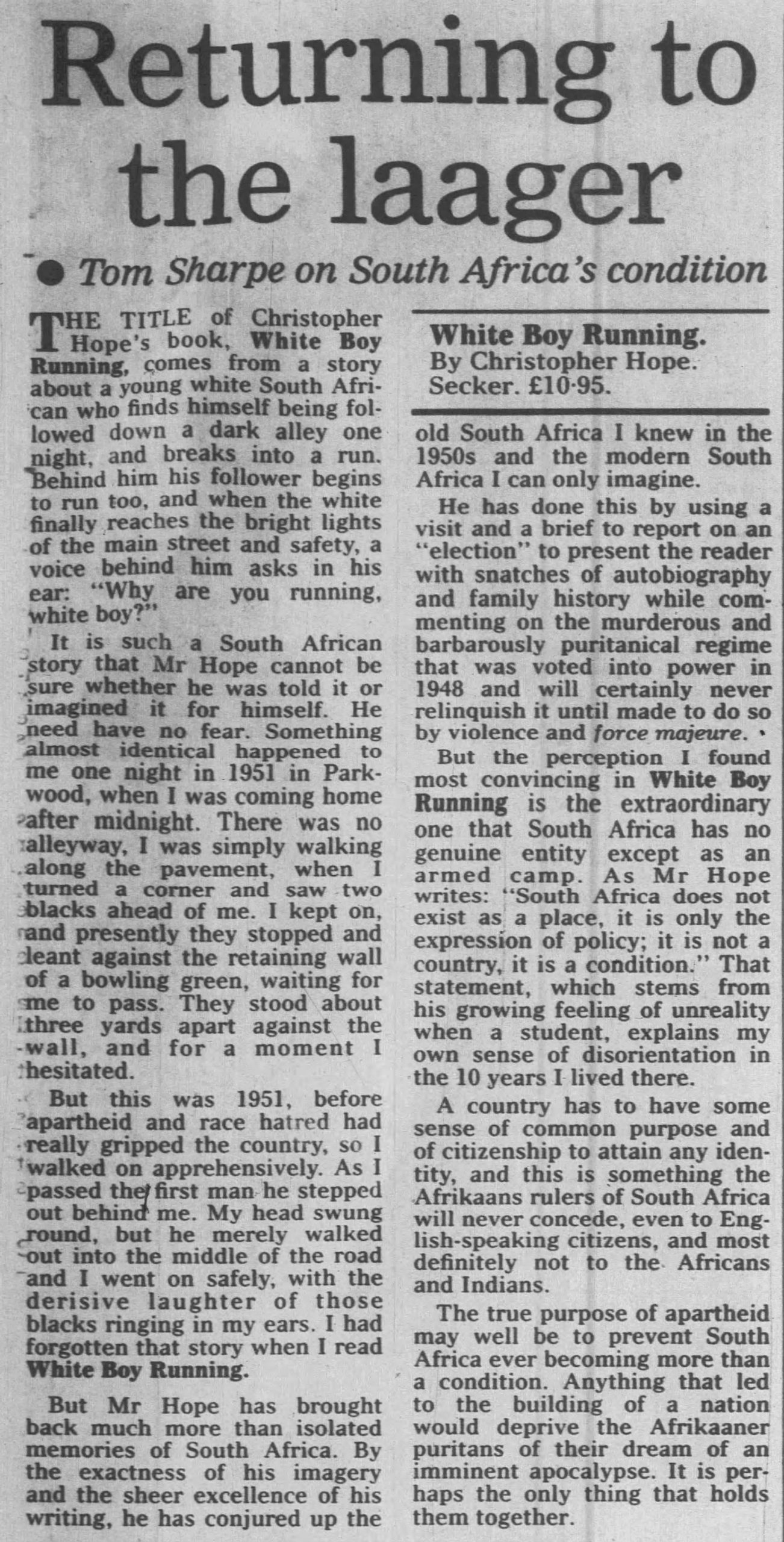
This article, penned by Tom Sharpe, was published in The Daily Telegraph on 27 February 1988.
THE TITLE of Christopher Hope’s book, White Boy Running, comes from a story about a young white South African who finds himself being followed down a dark alley one night, and breaks into a run. Behind him his follower begins to run too, and when the white finally reaches the bright lights of the main street and safety, a voice behind him asks in his ear: “Why are you running, white boy?”
It is such a South African story that Mr Hope cannot be sure whether he was told it or imagined it for himself. He need have no fear. Something almost identical happened to me one night in 1951 in Parkwood, when I was coming home after midnight. There was no alleyway, I was simply walking along the pavement, when I turned a corner and saw two blacks ahead of me. I kept on, and presently they stopped and leant against the retaining wall of a bowling green, waiting for me to pass. They stood about three yards apart against the wall, and for a moment I hesitated.
But this was 1951, before apartheid and race hatred had really gripped the country, so I walked on apprehensively. As I passed the first man he stepped out behind me. My head swung round, but he merely walked out into the middle of the road and I went on safely, with the derisive laughter of those blacks ringing in my ears. I had forgotten that story when I read White Boy Running.
But Mr Hope has brought back much more than isolated memories of South Africa. By the exactness of his imagery and the sheer excellence of his writing, he has conjured up the old South Africa I knew in the 1950s and the modern South Africa I can only imagine.
He has done this by using a visit and a brief to report on an “election” to present the reader with snatches of autobiography and family history while commenting on the murderous and barbarously puritanical regime that was voted into power in 1948 and will certainly never relinquish it until made to do so by violence and force majeure.
But the perception I found most convincing in White Boy Running is the extraordinary one that South Africa has no genuine entity except as an armed camp. As Mr Hope writes: “South Africa does not exist as a place, it is only the expression of policy; it is not a country, it is a condition.” That statement, which stems from his growing feeling of unreality when a student, explains my own sense of disorientation in the 10 years I lived there.
A country has to have some sense of common purpose and of citizenship to attain any identity, and this is something the Afrikaans rulers of South Africa will never concede, even to English-speaking citizens, and most definitely not to the Africans and Indians.
The true purpose of apartheid may well be to prevent South Africa ever becoming more than a condition. Anything that led to the building of a nation would deprive the Afrikaaner puritans of their dream of an imminent apocalypse. It is perhaps the only thing that holds them together.